IngaDB 0.1 · Product documentation
v0.1.0 · Self-hosted · Ready Deterministic · Same inputs, same numbers
THE CAUSAL ANALYSIS DATABASE

Cause and effect,
engineered.

Store causal models and incident evidence, compute deterministic risk analytics, and know exactly when every answer is still valid.

Start building Read the docs $ docker compose -f deploy/docker-compose.yml up -d
✓ Self-hosted, API-first, and revision-aware
production-line / analysis revision 42
EVENTBearing wearp = 0.032
EVENTSeal leakp = 0.018
OR GATEDrive failurep = 0.0494
TOP OUTCOMELine stopsP50 · 4.94%
Minimal cut sets02
Freshness Current

BUILT ON FOUNDATIONS ENGINEERS TRUST

R Rust PostgreSQL 16{ } OpenAPI▦ Docker◎ Deterministic
THE PROBLEMS WE SOLVE

Risk analysis breaks in familiar ways.

Each one has a structural cause. IngaDB removes the cause instead of patching the symptom.

01SCATTERED ANALYSIS

Critical risk knowledge is locked in diagrams and spreadsheets

PROBLEM

The model lives in a drawing tool, the incidents in a spreadsheet, the numbers in a report—and nobody can say which of the three is current.

SOLUTION

IngaDB keeps the model, the evidence, the computation, and the revision history in one queryable system, behind one HTTP API.

Typed graphSystem of recordHTTP API
02HAND-DRAWN TREES

Every hazard gets its own hand-drawn fault tree

PROBLEM

The same system is redrawn once per hazard, and each drawing drifts from the system it describes the moment it is finished.

SOLUTION

Describe the mechanism once—failure modes, propagation, redundancy—and compile the tree each hazard implies. Provenance names the facts behind every gate, and the compiler reports every branch it stopped at, and why.

CompilerDeviation vocabularyProvenanceCut branches
03UNREPRODUCIBLE NUMBERS

Can you reproduce that number later?

PROBLEM

A different analyst, tool version, or random seed shifts the figure — and if an LLM is doing the arithmetic, every run invents a new one. When an audit asks for the basis, not being able to rebuild the original computation is the real risk.

SOLUTION

Fixed traversal order, empirical-Bayes estimation from recorded incidents, and a constant Monte-Carlo seed: the same inputs always produce the same numbers, and the recorded input revision lets you rebuild the original computation any time.

Cut setsEmpirical BayesImportance measuresFixed seed
04STALE RESULTS

Reports outlive the systems they describe

PROBLEM

Evidence keeps arriving and topology keeps changing, but last quarter's numbers keep circulating with nothing to mark them as expired.

SOLUTION

Every analysis is stamped with its input revision. When the model or the evidence changes, IngaDB returns the exact delta that made the answer stale.

Revision stampsFreshnessExact deltas
05GUESSING AGENTS

AI agents answer risk questions from memory

PROBLEM

Ask an agent about failure probability and it improvises a plausible number, because it has no causal store to query.

SOLUTION

The retrieval API and ingactl give agents deterministic, revision-stamped answers—search, causal paths, evidence, importance, cut sets—with dry-run before execute.

Retrieval APIingactlDry-run first
SCOPED ON PURPOSE

Every answer states its basis—and its boundary.

IngaDB doesn't just return a number. It returns what the number rests on, and where the model's competence ends.

◎ What every answer carries

Each result ships with its own audit trail, as data.

  • The input revision it was computed from
  • The evidence basis behind each probability
  • The mechanism facts behind each compiled gate
  • Every branch the compiler stopped at, and why

▣ How the answer stays safe

The write path is guarded so results stay defensible.

  • Compilation is read-only: it returns the tree, writes nothing
  • What-if exploration never touches stored data
  • Mutations, revision bumps, and deltas commit atomically
  • Destructive routes require explicit confirmation
ONE SYSTEM OF RECORD

From raw evidence to a defensible answer.

Three capabilities, one pipeline: model the causal structure, quantify it from evidence, and keep every computed answer honest about its age.

01
CAUSAL MODELS

Model how systems fail—not just what failed.

Represent events and AND/OR gates as typed graph data. Compile fault trees from failure modes, propagation paths, and redundancy facts without redrawing them.

Events & gatesMechanism factsFault-tree compiler
Explore causal models
02
DETERMINISTIC ANALYTICS

Quantify risk with reproducible math.

Compute cut sets, empirical-Bayes probabilities, importance measures, and fixed-seed uncertainty bands. The same inputs produce the same numbers.

Cut setsFussell-VeselyBirnbaumP5 / P50 / P95
03
REVISION AWARE

Never trust a stale result again.

Every analysis is stamped with its input revision. When evidence or topology changes, IngaDB returns the exact delta that made the answer stale.

Revision stampsFreshnessExact deltas
AGENT × ENGINE

Ask the agent. The engine computes the answer.

The conversation belongs to the agent; the computation to the deterministic engine. What-if runs without touching stored data, stamped with its revision.

agent — packaging-line revision 42
If we halved the seal-leak probability, what happens to line stops?
✓ What-if✓ engine-computed
current (revision 42)4.94%
→
halved scenario4.07%
≈1/1.2

Verified by the engine: halving seal leak lowers the top event "line stops" from 4.94% to 4.07%. Nothing stored was touched.

Ask it again.

Same inputs, same answer — 4.07% (revision 42). No improvised numbers.

RUNNING IN PRODUCTION

The same engine powers a real product.

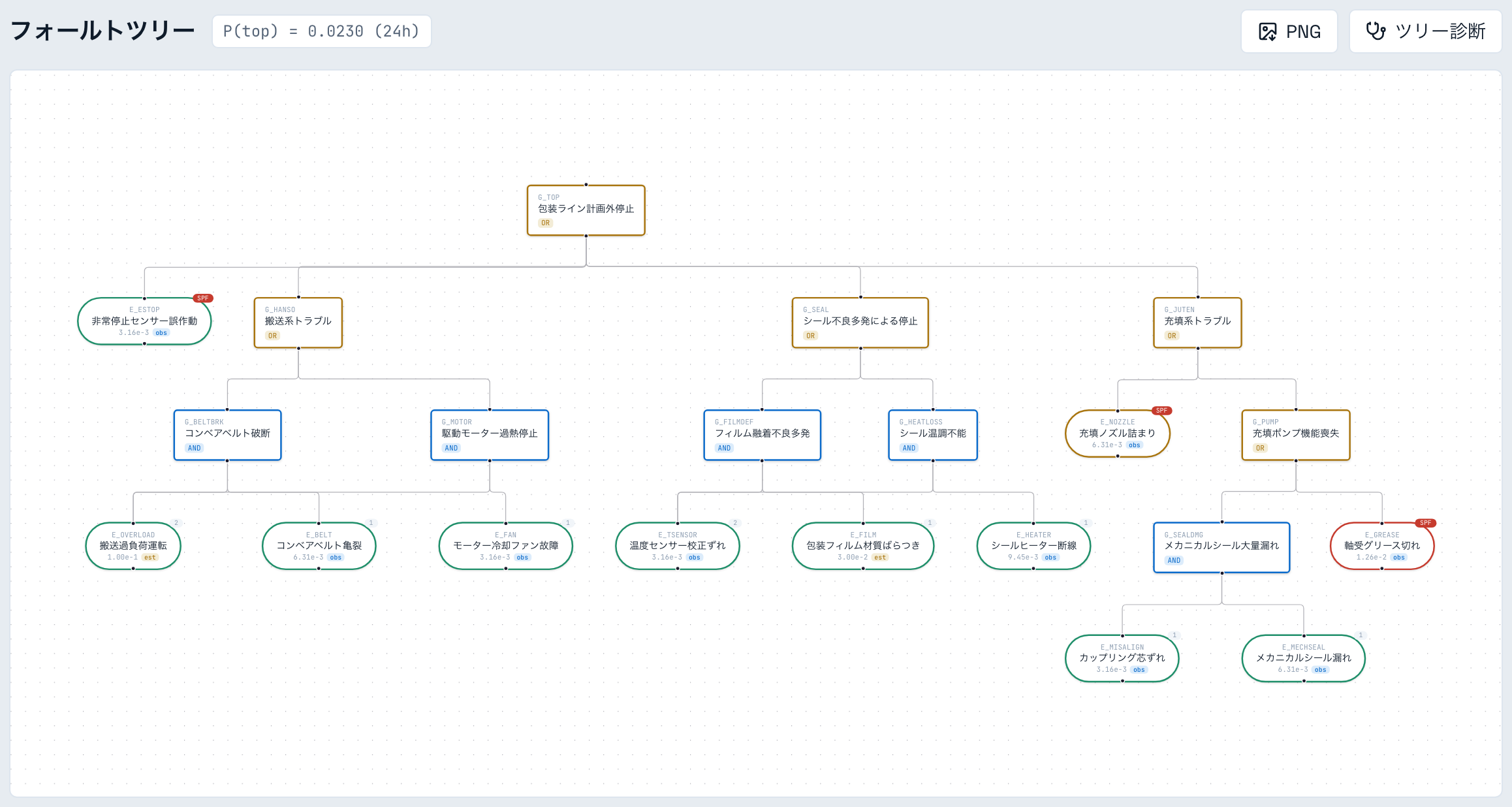
Our failure-knowledge platform, Causation, structures trouble reports and maintenance records with AI and quantifies countermeasure effects with a calculation engine — running in production on the same causal engine as IngaDB, with the same division of labor: AI extracts, people approve, a deterministic engine computes.

Causation
過去トラを、資産に変える。
Causation's fault-tree screen: a packaging line's unplanned stop decomposed through AND and OR gates, each event carrying an evidence-derived probabilityhozen.cognitech.dev — the actual fault-tree screen
GO DEEPER

Interested? The depth lives in the docs.

That was the core of IngaDB. Worked examples, architecture placements, and measured performance are covered in detail in the documentation.

WHY INGADB

A world model, scoped on purpose.

Causal effect reasoning is one form of world model—in a limited scope. IngaDB serves that scope as data: mechanisms of how systems fail, compiled into fault trees, quantified from recorded incidents, and stamped with the revision they were computed from. And the model knows where it ends—every compiled tree names the exact branches the compiler stopped at, and why.

Deterministic

The same inputs produce the same numbers, every run.

Evidence-derived

Probabilities come from recorded incidents, with their basis attached.

Boundary-aware

Every answer reports where the model's competence ends.

FREQUENTLY ASKED QUESTIONS

Got questions? We have answers.

Everything you need to decide whether IngaDB fits your stack. Anything else, write to [email protected].

What is IngaDB?

A causal analysis database. It stores fault-tree models and the incident evidence recorded against them, computes deterministic risk analytics—cut sets, probabilities, importance measures, uncertainty bands—and tracks which results are still valid as models and evidence change.

Where do the probabilities come from?

From recorded incidents, by empirical-Bayes estimation. When an event has little evidence of its own, its estimate is pooled across the workspace—and every probability reports the basis it was derived from.

Do I have to draw fault trees by hand?

No. Describe the system once as mechanism facts—failure modes, propagation paths, redundancy—and compile the fault tree each hazard implies. The compile is read-only, names the facts behind each gate, and reports every branch it stopped at, and why.

What happens when the model or the evidence changes?

Every analysis is stamped with the revision it was computed from. After a change, IngaDB tells you whether a result is still fresh and, if not, returns the exact delta—which facts, incidents, or topology edits—made it stale.

Can AI agents use it?

Yes. The command catalog that documents the API also drives ingactl, so an agent can sync the catalog, read each route's contract and required permission, dry-run, then execute. Retrieval routes cover search, causal paths, evidence, importance, and cut sets—every answer deterministic and revision-stamped.

How do I run it?

Self-hosted, on your own infrastructure: one binary beside PostgreSQL 16, two containers with the bundled Docker Compose file. API keys, RBAC, and an audit trail are built in, and typed TypeScript and Python clients are generated from the OpenAPI contract.

BUILD ON CAUSAL TRUTH

Make every risk decision traceable.

Bring causal models, evidence, and revision-aware analytics into your stack.